Build it… will they come?
You have tinkered with the AI set-up, added files, thought carefully about the flow and pedagogical intentions, and rolled up your sleeves to build an AI tool for your students. You add it to the LMS, wait for students to engage … and, two weeks later, discover that only a handful have used it.
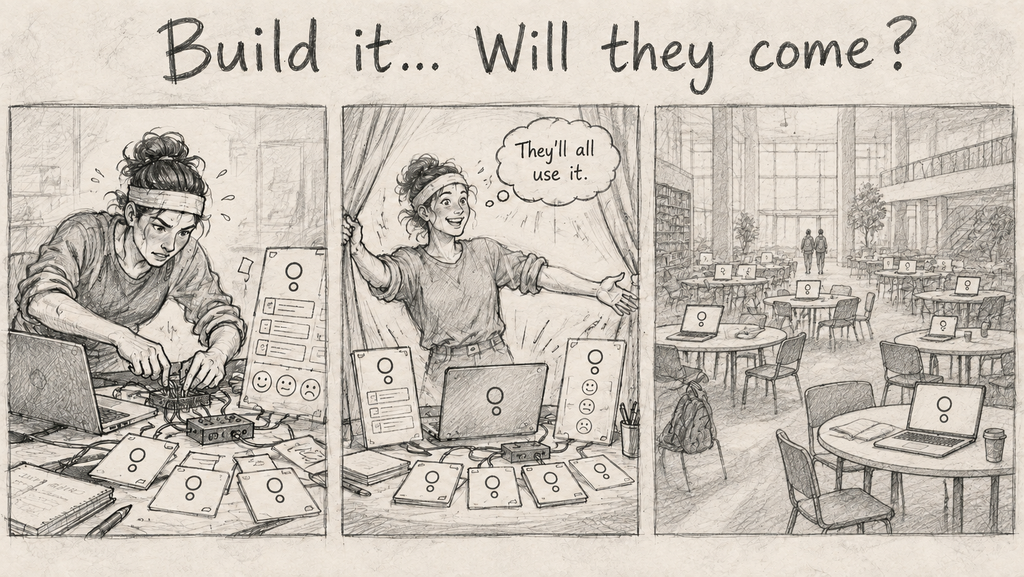
Sound familiar?
You are not alone. At our recent Cogniti Connect community webinar, attended by 160 educators, around 80% of participants said they could relate to the challenge of low student engagement with AI tools, even when those tools have been thoughtfully designed and clearly connected to learning.
The session explored a deceptively difficult question: if we build useful AI learning tools, what helps students use them?
From 10% usage to meaningful uptake
Our first speaker, Pierre Naeyaert, shared his experience of discovering that only… around 10% of students(!) were initially engaging with an AI tool he had developed for the chemistry labs.
He made some changes, mainly to communication, and spoiler alert: engagement improved. Watch Pierre’s contribution to hear from him directly.
Make space to use the tool
Our second contributor, Robert Annabel, who teaches Business students, faced a similar challenge but took a different route. After seeing a low uptake of the AI tool which he was confident would help students, he created time during a tutorial for students to use it.
This gave students an opportunity to try it with support, discuss with Robert and test it out alongside others. Engagement increased after the tool became part of the teaching experience rather than simply an optional resource in the LMS.
His presentation also raised some important design questions: How much guidance should we provide? Is it really important to set the tutorial time for the agent use? What is the optimal way to configure the agent – should it yield and provide answers? If so, how soon?
Watch the full presentation below.
What do students think?
To extend the discussion, a colleague from Otago University Carrie Falling shared insights from student focus groups exploring how students perceive Cogniti agents.
Her sharing added an important student perspective.
The focus-group findings reinforced a key theme from the session: student engagement needs to be designed for and planned for, not assumed.
Exploring Cogniti Sandboxes
We also discussed Cogniti Sandboxes, which allow educators to create spaces for students to explore, test ideas and interact with AI in a more structured environment.
A poll during the session showed that 77% of participants had not used Sandboxes before. Carmen Vallis’ contribution was therefore especially timely. She shared her experience of using Sandboxes with students, including what prompted her to try them and what she learned from the process.
Key takeaway
The fact that so many people could relate to feeling disappointed that not as many students as they would have hoped leverage the AI tools that they’ve built points to the importance of having a plan to encourage students to try the tools.
Communication seems key. And not just any type of communication, but the communication that would both clearly show the relevance of the tool, and will also acknowledge and address the emotional barriers that might get in the way of the students trying the tools.
Even when students’ AI literacy builds and more might be willing to give these tools a go, it appears that communicating clearly and supporting the use by showing students how to use the activity, maybe setting aside the time during the tutorial or a lecture might be important.
Thank you to everyone who joined Cogniti Connect and to our speakers for sharing their experiences so generously.
In our future sessions, we’ll also be unpacking the question of how to make the designs more effective. In other words, how do we ensure that once the students do open the door, the stairs lead them up rather than keeping them on the same level or maybe even taking them down.
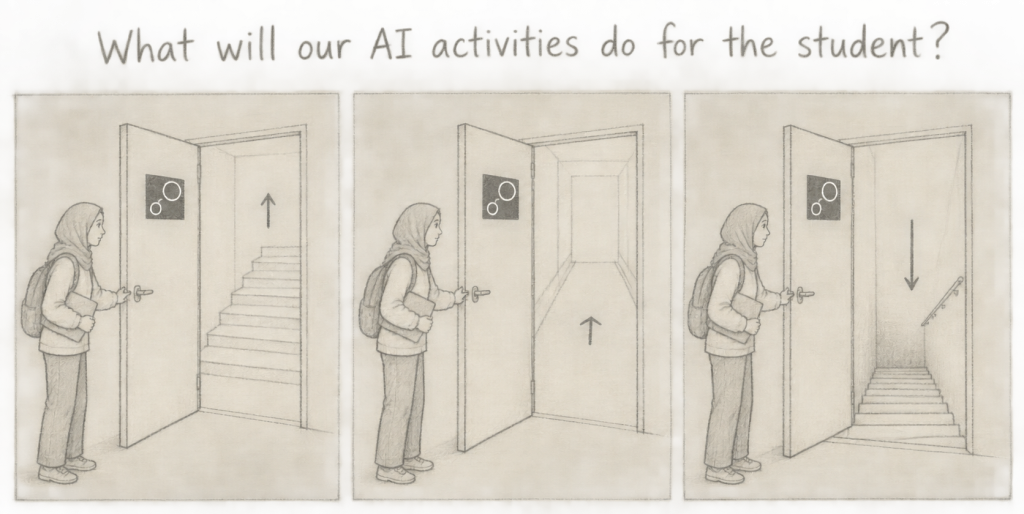
Image credits: All images in this post are AI generated by Olga Kozar
Note: AI-assisted copy-editing was used to improve readability. All substantive content and final editorial decisions remain the author’s own.