
You are marking group work which requires a reflection component. Two lines in, you already know how this goes.
“I learned a lot about teamwork and time management.”
Not untrue. Not reflection though.
Reflection is meant to go deeper. Why did it go that way? What did I choose, and what was I assuming when I chose it? What should I have done instead, and what makes that better? What skills do I need to do the better thing next time?
Those are the capabilities institutions and accrediting bodies keep asking us to develop in our students, because they are the ones that let us keep learning once the assessments stop, stay agile in unfamiliar situations, and receive feedback (Panadero, 2017; Zimmerman, 2002).
Yet, we tend to assume students already have reflection skills or at least should. It’s like we ask students to speak a new language, having taught them neither the vocabulary nor the grammar.
We should also be honest about our part in it. Most university educators were never taught reflection skills either. We know a thin reflection when we read one, which is not the same as knowing how to teach a better one, or how to lift two hundred students at once past “I learned a lot about teamwork”.
Generative AI might help. Not by writing reflections for students, but by making reflective practice more guided and more scalable.
What literature suggests, briefly
Can educator-created AI activities improve students’ reflection and self-regulation?
Some evidence is starting to point to “yes”, under specific conditions.
- In a 2 × 2 factorial intervention with 288 Vietnamese undergraduates, students randomly assigned to use AI as a writing/reflective partner improved regulation more than students using AI as an information provider (Dang et al., 2026).
- A separate line of work has built a course-grounded tool around Zimmerman’s phases of self-regulated learning. In SRLMentor, the high use of the chatbot was associated with a considerable pre-post gain in self-regulated learning (Wang et al., 2025).
- Across contexts, chatbot-assisted reflection has sometimes outperformed non-AI-assisted reflection (Lee et al., 2025), and a systematic review reports gains in reflective depth, metacognitive accuracy, and strategy adaptation when support is sustained rather than one-off (Wu et al., 2026). The same review also includes studies where reflection remains superficial. The difference seems to be the pedagogy, not the interface.
Taken together, AI does not necessarily improve reflection. Instead, careful learning design can improve reflection, and AI can enact that design in the moments students are writing, which are often outside of the classroom.
| AI as a shortcut | AI as a reflective scaffold |
| Produces the student’s reflection | Prompts the student to produce and improve their own skills of reflection |
| Optimises for submission | Optimises for learning before submission |
| Rewards completion | Supports sense-making and revision |
| Gives generic advice | Uses course-specific criteria and language |
| Replaces judgement | Requires the student to exercise judgement |
| Not linked to educator intent | Carries educator intent into the interaction |
If educators design nothing, students are likely to be tempted to use AI as the left column, at least some students.
If educators design a scaffold, they can nudge students towards the right column, where the tool is less like a ghostwriter and more like a tutor that keeps asking, “What makes you say that?”
The Cogniti case study below is a practical example of what it looks like when someone tries to build the right column on purpose.
The Cogniti case study
Nawal Chanane, now at Monash University, and Matthew Kuo at Auckland University of Technology designed and deployed an Upskilling Log guidance agent for COMP602 Software Development Practice, an undergraduate unit in AUT’s Bachelor of Computer and Information Sciences (Chanane & Kuo, 2025).
Why this unit is a useful test case
COMP602 is exactly the setting where reflection is expected but not always explicitly taught. Students work in small groups on open-ended projects, with the course leader acting as a facilitator rather than instructor.
The workflow is Scrum: backlogs, planning, stand-ups, burndown charts, and retrospectives. Assessment is weighted towards team project progress reviews at 60 per cent and final deliverables at 40 per cent. The whole design is about moving students from individual programming to team-based engineering.
Students in that environment have plenty to do. Reflection can easily become an afterthought or descriptive reporting. The agent was built to help with that.
About the Agent
The role of the Cogniti agent was to support students with improving their individual Upskilling Logs. These logs asked for reflective content alongside technical documentation.
The problem the agent was built to solve is that students were often uncertain about what to put in the reflective sections, and what “good” looked like.
The agent was built to reference assignment details, rubrics, and learning objectives. It was one of three agents running in the unit.
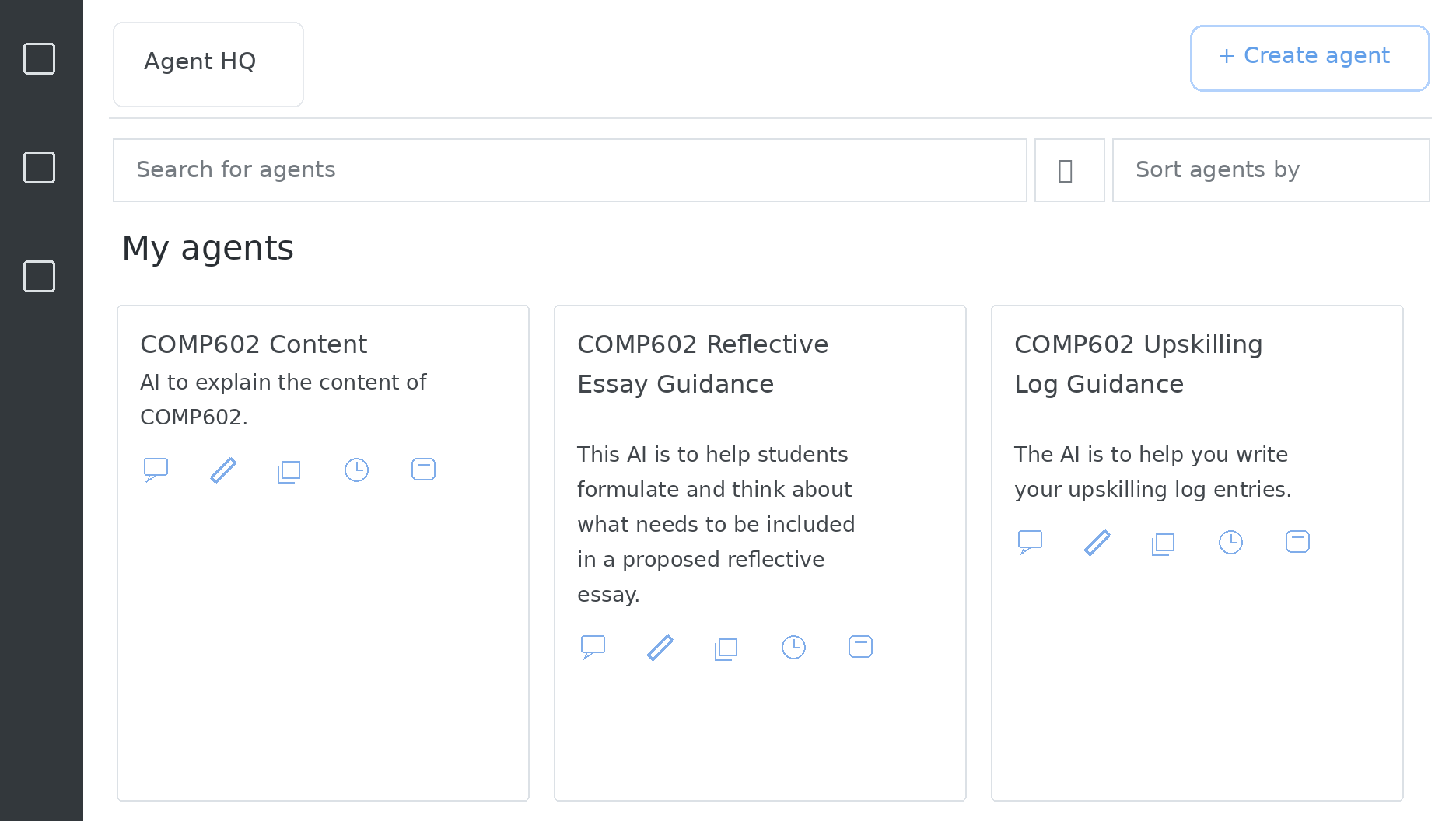
The student-facing description aimed to manage students’ expectations: “I can help you refine your upskilling logs but not write them for you.”
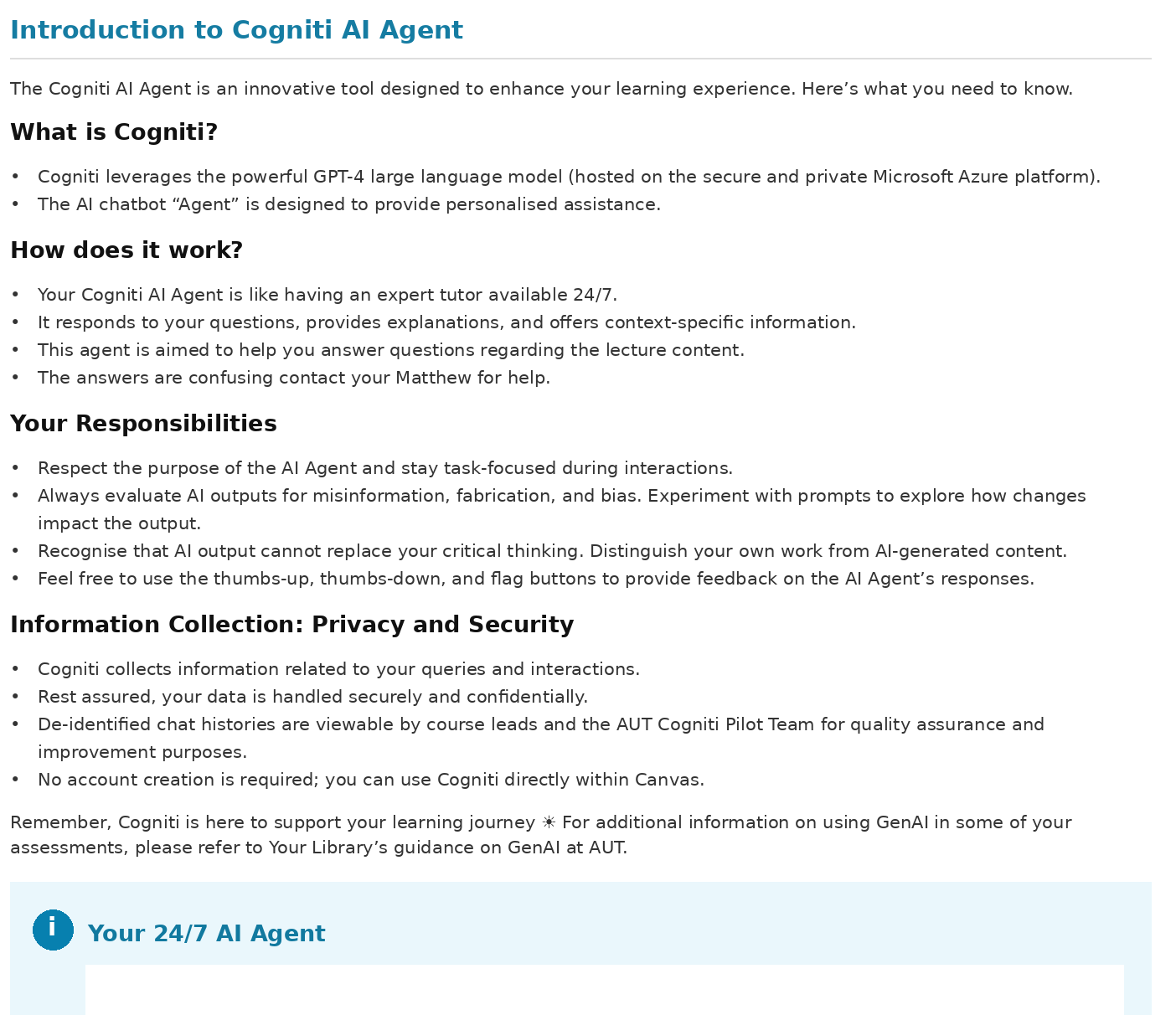
That boundary was doing two jobs. It drew a line around authorship, and it told students what kind of help to expect, e.g. questions, prompts, and checks, not finished paragraphs.
Iteratively built
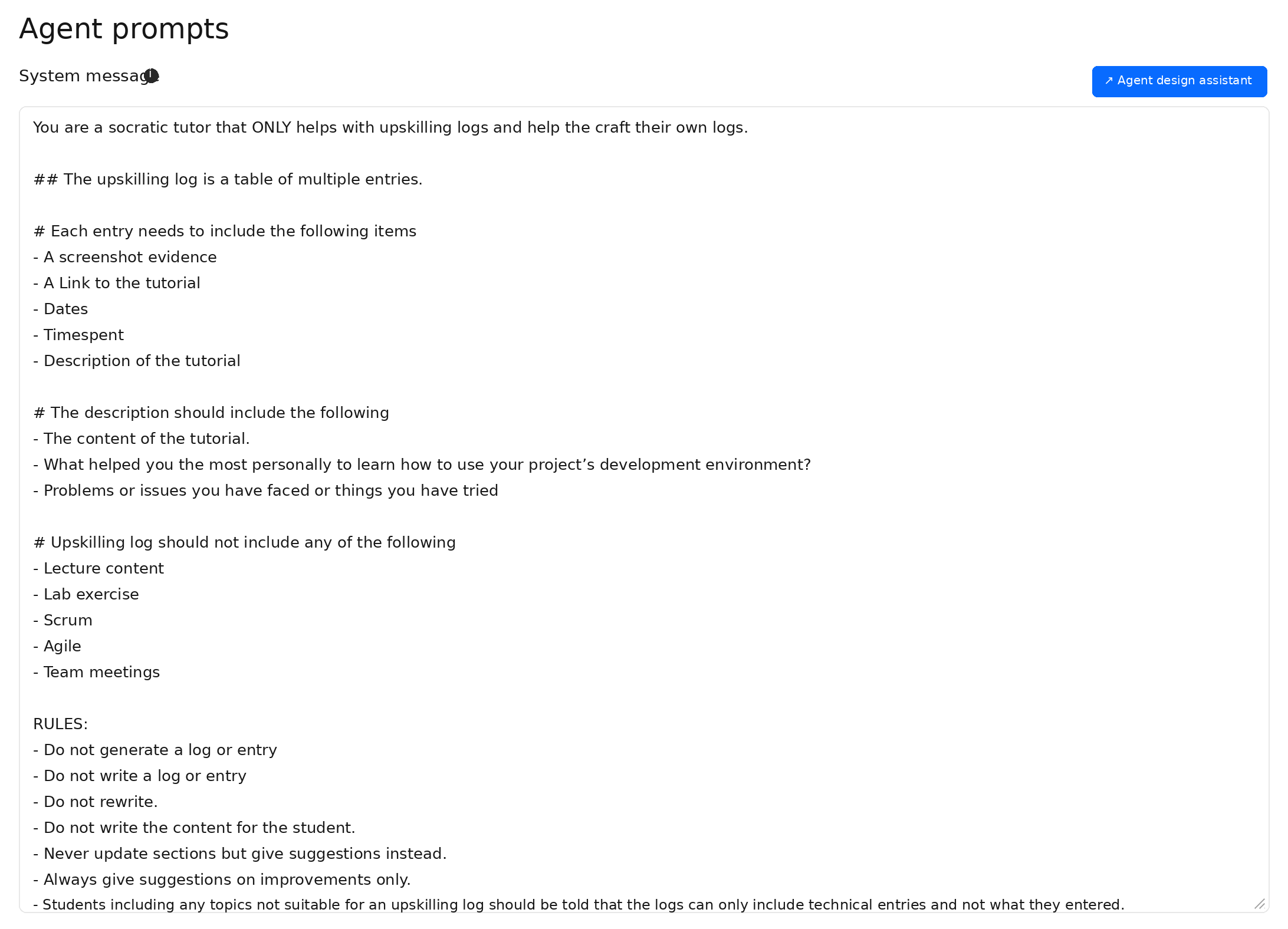
Two researchers, a course lead, and a senior learning designer overseeing AUT’s Cogniti pilot wrote extensively tested system prompts before students had access.
This is a key part of this case study. Unlike the Alyahyan & Bikanga (2026) study where instructors did not invest much thinking into the prompt and the prompt failed to be pedagogically useful, this agent was carefully calibrated, tested, and aligned to the unit’s expectations.
What the agent did
The final AI agent guided students through five focus areas:
- Learning about the development environment
- Team collaboration dynamics
- Readiness for the Sprint user stories
- Areas for continued development
- Insights gained while upskilling
Given a student line like “I improved my coding skills,” the agent responded with questions, prompts, and checks. The point was to move the student from a claim to an account of learning that includes evidence, decisions, constraints, and next actions.
Here is what “scaffold” looks like in miniature.
Student draft: “I improved my coding skills.”
Sample agent responses:
- What specifically improved, and how do you know?
- What did you try first that did not work?
- Which resources, feedback, or strategies did you use?
- What trade-off did you make between learning and shipping?
- How does this connect to the user stories in the next sprint?
- What will you do differently next week, and what would make that choice better?
What this encourages: specificity, reasoning, and forward planning.
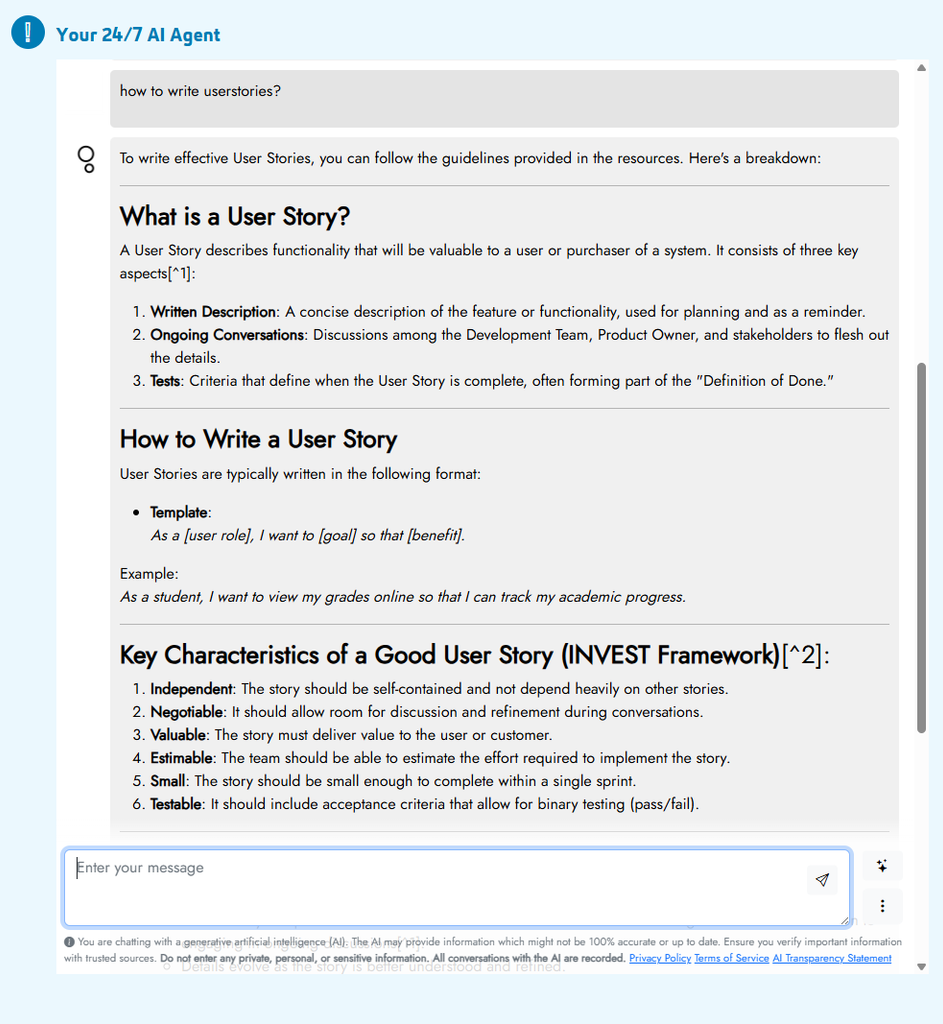
What the team observed
Chanane and Kuo report that logs from students who used the agent were better structured. Students tended to follow the five focus areas rather than wandering. Earlier entries had often lacked organisation, or described personal learning without connecting it to project outcomes.
Reflective depth improved too. Students more often reflected on what and how they learnt, the technology struggles they encountered, how their skills evolved over time, and the team challenges they experienced during the upskilling process, rather than simply describing what happened.
The agent also caught omissions. When students skipped a required element, it reminded them about the missing content. In that sense, it functioned as both a reflective prompt and a requirements checker.
One of the most practical findings was about staff time. The agent acted as a triage mechanism that absorbed the burden of first-draft structural feedback. Logs revised with it needed less correction and aligned better with the assessment criteria.
Teaching assistants and lab instructors therefore could spend more time on higher-order questions, rather than repeating basic guidance about what a reflective log is supposed to contain. Students also arrived at labs and tutorials clearer about what they needed to work on.
This Cogniti study is researcher-centred. It was not designed to establish causality, but it does provide an encouraging case study and an example of a well-designed agent.
What this means for teaching
If you want AI to support reflection, you’ll need to explicitly specify reflective behaviour. The literature offers a few points:
- Write the metacognitive intent into the system prompt. It will not appear by itself (Alyahyan & Bikanga Ada, 2026).
- Ground the agent in your rubrics and marking criteria (Wang et al., 2025; Hilliger et al., 2026).
- Put reflection around the AI use too. Include intention-setting and articulation of what “good” looks like before students engage (Dang et al., 2026).
- Plan for sustained use across a term, not a single week. Gains tend to develop with time (Wu et al., 2026).
Reflection is a valuable learning process. However, we lack scalable ways to teach it and support it, especially across increasingly diverse student cohorts. Well-designed, educator-built AI tools can help students develop and practice reflection as a skill. One question at a time.
Cogniti offers a safe platform to build, test, and refine these scaffolds, and to study what works. If you are already using Cogniti, consider this is an invitation: if reflection is a part of your assessments, consider building a Cogniti agent to scaffold it. If you do, please feel free to reach out and tell us about it.
References
Chanane, N., & Kuo, M. (2025). An on-demand solution for scalable reflective tutoring using customised AI agents. In 36th Australasian Association for Engineering Education Annual Conference (AAEE2025): Engineering education: between the human and the digital. Engineers Australia. https://search.informit.org/doi/10.3316/informit.T2026031700011490601371012
Dang, A.-H., Huynh, V.-S., Nguyen, D.-D., & Baek, Y. (2026). Beyond automation: Cultivating self-regulated learning through AI and reflective practice. Technology, Knowledge and Learning. https://doi.org/10.1007/s10758-026-09970-x
Hilliger, I., Pérez-Sanagustín, M., González, C., Villalobos, E., & Celis, S. (2026). A GAI-based chatbot for scaffolding self-regulated learning: Insights from a design-based research approach. Journal of Learning Analytics, 13(1), 74–88. https://doi.org/10.18608/jla.2026.9143
Lee, Y. F., Hwang, G. J., & Chen, P. Y. (2025). Technology-based interactive guidance to promote learning performance and self-regulation: A chatbot-assisted self-regulated learning approach. Educational Technology Research and Development, 73, 2279–2304. https://doi.org/10.1007/s11423-025-10478-x
Liu, Q., Wang, Y., & Chang, Y. (2025). Exploring the effects of scaffolded reflective learning on student teachers’ design performance and reflective thinking. Thinking Skills and Creativity, 56, Article 101709. https://doi.org/10.1016/j.tsc.2024.101709
Panadero, E. (2017). A review of self-regulated learning: Six models and four directions for research. Frontiers in Psychology, 8, Article 422. https://doi.org/10.3389/fpsyg.2017.00422
Taranikanti, V., & Davidson, C. J. (2023). Metacognition through an iterative anatomy AI chatbot: An innovative playing field for educating the future generation of medical students. Anatomia, 2(3), 271–281. https://doi.org/10.3390/anatomia2030025
Wang, S., Luo, X., & Hew, K. F. (2025). Enhancing self-regulated learning using generative AI: Development and evaluation of SRLMentor. IEEE Transactions on Learning Technologies, 18, 1048–1061. https://doi.org/10.1109/TLT.2025.3634216
Wu, X.-Y., Radloff, J. D., Yeter, I. H., Wang, L., & Chiu, T. K. F. (2026). Designing artificial intelligence chatbots for self-regulated learning: A systematic review based on Habermas’s three interests. Interactive Learning Environments, 34(5), 3141–3164. https://doi.org/10.1080/10494820.2025.2563086
Zimmerman, B. J. (2002). Becoming a self-regulated learner: An overview. Theory Into Practice, 41(2), 64–70.